

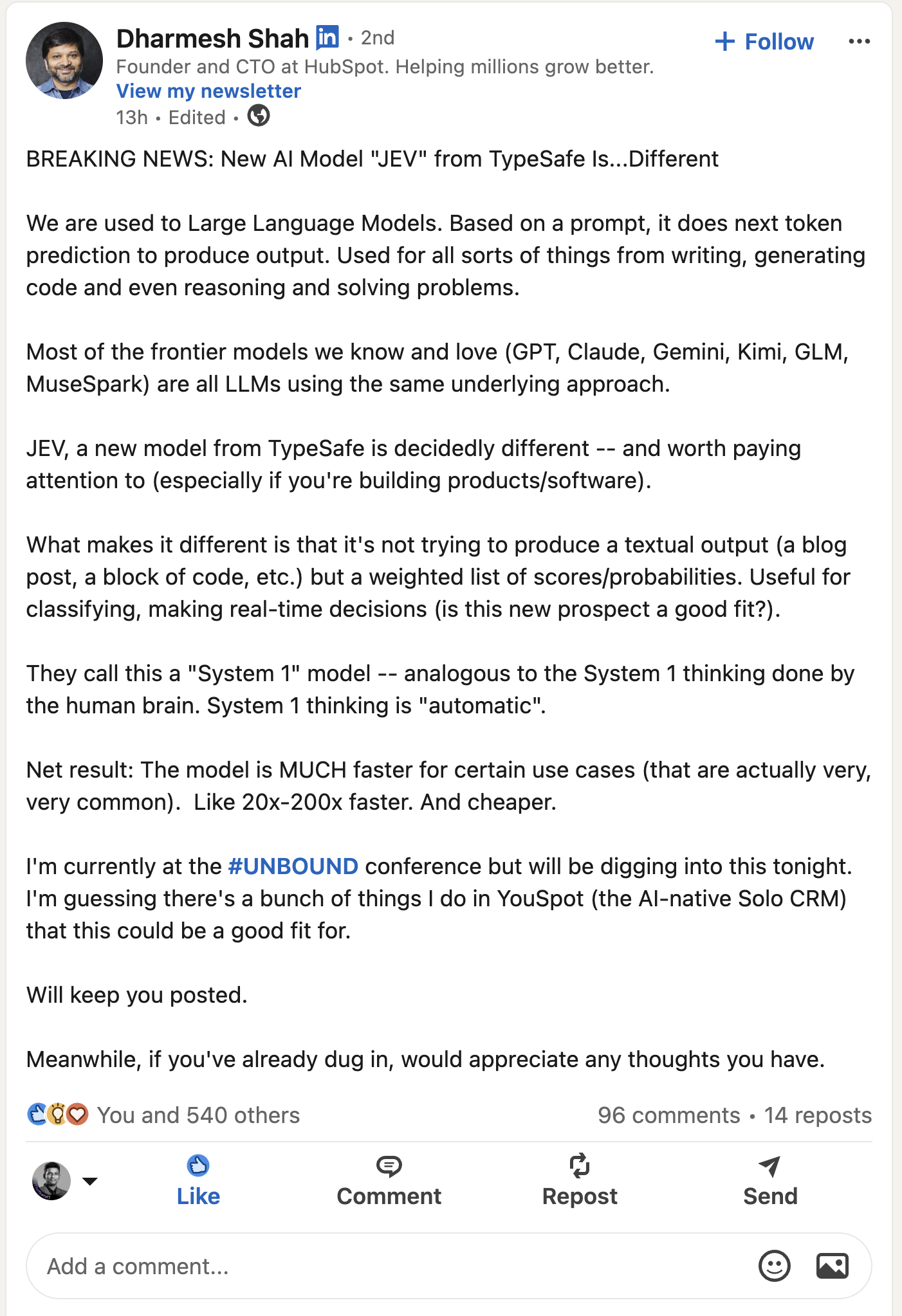
Jev caught my attention today, thanks to a post from Dharmesh Shah. I went down a rabbit hole with it, and it left me thinking hard about SEO. So my team and I built a small prototype and tested seven real use cases. Here is what I found, and what I am still not sure about.
What is Jev?
Jev is a new kind of AI model from a lab called TypeSafe. Most AI tools we use, like ChatGPT and Claude, are built to write. You ask a question, they write an answer. Jev is different. It is a decision model. You give it some context and a set of choices, and it picks one. It does not write a long reply. It just makes the call, and it tells you how sure it is.
The easiest way to picture it: a normal AI is a writer, and Jev is a judge. The writer hands you paragraphs. The judge hands you a verdict and a confidence score. That small shift turns out to matter a lot.

Why this got me thinking about SEO?
Here is what hit me. In SEO, we spend a lot of time using AI to make things. We write titles. We write meta descriptions. We draft content. But a huge part of SEO is not making things at all. It is making small decisions, over and over.
Which page should this link point to? Is this title better than that one? What is the intent behind this keyword? These are not essays. They are choices. And we have to make them thousands, sometimes millions, of times.
That is a strong fit for a decision model. It is fast. It is cheap. And it gives a confidence score, so you can act on the clear calls and stop to check only the close ones. A person doing this by hand gets tired and slow. A model does not.
7 SEO use cases I tested
I put together a quick prototype and walked through seven jobs where Jev could help. Here they are.
- Pick the best internal link. You have a sentence that needs a link and a few pages it could point to. Jev picks the best target and scores the rest. Now imagine doing this across a whole site with thousands of links.
- Pick the best page title. You write three titles for a page. Jev picks the one most likely to work for your keyword, and shows how the others score.
- Pick the best meta description. Same idea. A few options go in, the strongest one comes out, with a confidence score.
- Sort keywords by intent. Paste a list of keywords. Jev tags each one as learn, compare, buy, or brand. I ran fifty at once. It sorted them all in about a second and flagged the close calls for a human to check.
- Classify a search prompt. Take a real question someone asks an AI tool and decide the buyer stage. Is this person just curious, doing research, or ready to buy?
- Triage outreach. That flood of link requests and cold emails. Jev sorts them into worth a reply, polite decline, or spam. It even catches the sneaky paid-link asks that are dressed up to look like real offers.
- Map redirects in a site move. You are removing an old page. Jev picks the best new page to redirect it to, from a list of options.
The pattern is the same every time. A small decision, made the same way, at a scale no human can match by hand. That is the whole point.
What I still do not know
I am excited, but I am not sold yet. There is a lot we do not know.
We do not know what Jev was trained on. The full design has not been shared. And we do not yet know how reliable its confidence scores are in real work. A model can sound sure and still be wrong. When your whole job is trust, that matters a great deal.
It is also very new. So the smart move is to test it on real data first, not to bet a big system on it on day one.
Where this goes
For me, the interesting part is not this one model. It is the idea behind it. So much of SEO is decisions, not words. A fast, cheap model that makes a call and tells you how sure it is could sit under a lot of the work we do every day.
I am curious to see where this goes. And I would love to hear from you. What other SEO jobs would you hand to a decision model like this?
Watch the video walkthrough, and tell me what you think.

Do you want more traffic?


OpenAI Dots Explained: How ChatGPT’s Always-On Agents Work, and How They Compare to Meta Muse
.jpg)