TL;DR
1. AEO means answer engine optimization. It helps your expertise and brand appear accurately in answers across search features and AI assistants.
2. Answer engines may retrieve relevant information, assess sources, and generate a response. A citation, brand mention, and recommendation are different outcomes.
3. Strong SEO remains essential. Useful content, accessible pages and credible evidence support discovery across search and AI experiences.
4. Start with real buyer questions. Improve the pages that answer them, keep business information accurate, and earn relevant industry coverage.
5. Measure answer visibility alongside qualified inquiries. Repeat your checks across platforms and buyer contexts before declaring progress.
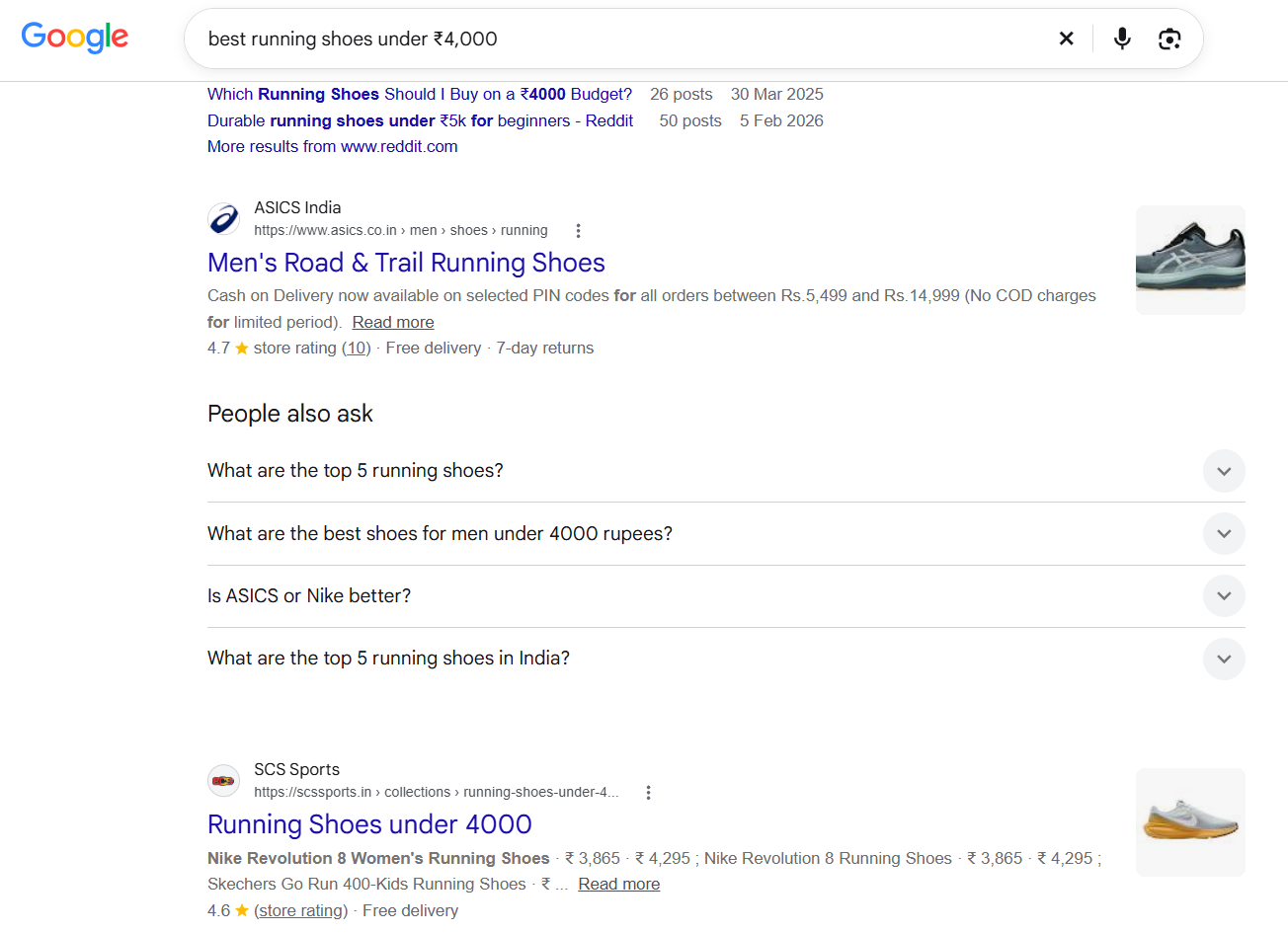
Let's begin with a simple demonstration. Go to Google and search for the “best running shoes under ₹4,000”. The results may include product listings from Flipkart, Asics, and Amazon; running guides; and videos reviewing different pairs. You open a few, compare prices, check the cushioning, and decide which shoes suit your routine.
Now ask the same question in Google AI Mode, adding that you run five kilometers every morning. It can pull information from several sources into one answer, suggest options, and explain how they fit your requirements. You can then ask about durability or compare two pairs without starting your research again.
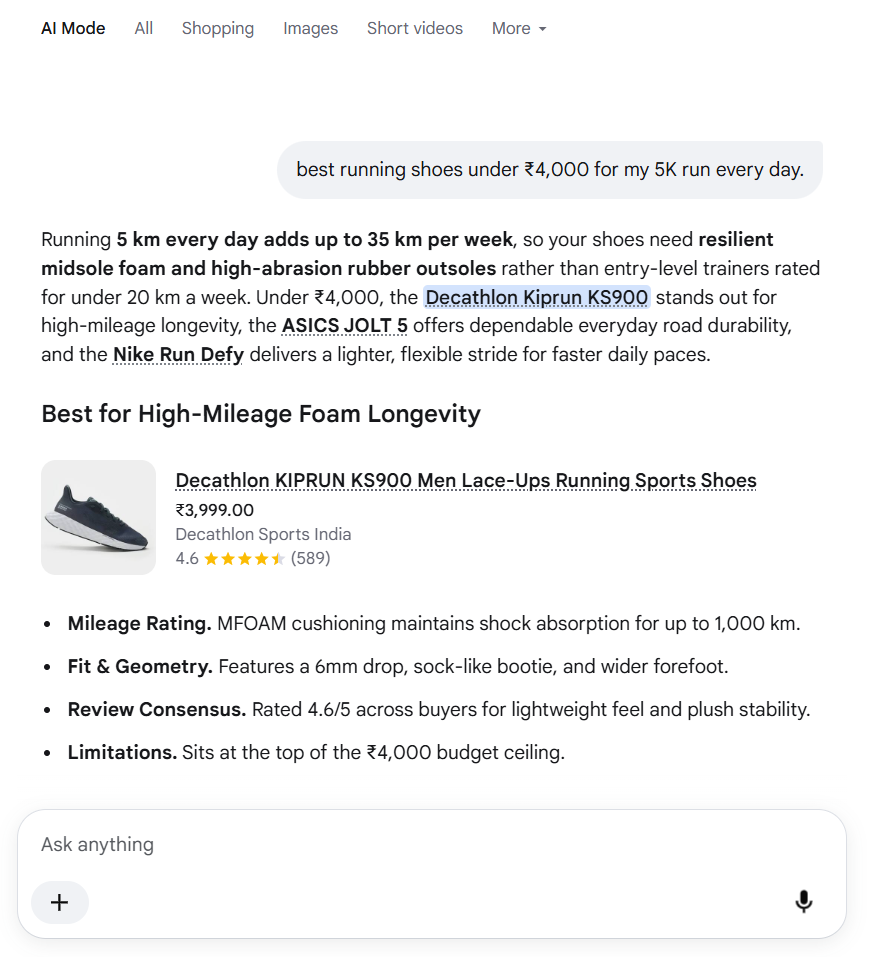
By the time you visit a retailer’s website, you may already know which pair you want to check.
For a footwear brand, getting its product page found is one part of the job. Getting its shoes included and accurately described in that answer matters too.
AEO meaning and where it applies
Answer engine optimization, or AEO, improves how your content and business appear in direct answers. It covers the information you publish, how easily systems can access it, and the evidence available about your brand elsewhere.
Relevant surfaces include Google featured snippets, AI Overviews, AI Mode, ChatGPT search, Perplexity, Gemini, Microsoft Copilot and voice assistants. Featured snippets generally extract information from a page. Generative answers can combine information from several sources.
Three outcomes deserve separate attention:
A mention names your brand.
A citation references a source, often through a link.
A recommendation presents your business as suitable for a particular requirement.
A cited definition may earn visibility without recommending your company. A recommendation may reference an independent review rather than your website.
Why does AEO matter for B2B brands?
Think of a business buying 30 office chairs. Someone on your team puts it on ChatGPT to suggest suppliers that offer adjustable chairs, bulk pricing, and delivery to Mumbai.
If the answer names three suppliers and explains what each offers, those businesses have a chance of getting contacted. The buyer has a starting point without having visited their websites.
Getting the details right matters too. Suppose the answer recommends your company for installation, but you only deliver the chairs. The enquiry begins with an expectation you cannot meet.
AEO gives brands a reason to look closely at those answers.
Are your products included in relevant comparisons?
Are prices, delivery areas and service terms described correctly?
Your brand’s assets, like your website and social media accounts, should make those details easy to find and verify. Buyers need enough information to decide whether contacting you is worth their time.
How does AEO work?
AEO improves the information available to answer engines. The engines control retrieval and presentation, so no optimization guarantees inclusion.
For an answer supported by web search, a useful working model has four stages. Platforms differ in how they implement them.
1. Interpret the question
The system interprets the request and available context. Industry, location, budget and earlier conversation can change what counts as a useful answer.
Someone looking for shoes for a daily five-kilometre run needs different recommendations from someone looking for comfortable shoes to wear at work. The budget may be identical, but the intended use changes the answer.
2. Find relevant information
An AI search tool can look up several things to answer one question. For example, at the beginning of our blog, where we wrote the query, ‘best running shoes under ₹4,000’, it might check prices, look for shoes suited to daily running, and find reviews on comfort and durability.
Google calls this related-search query fan-out. Information across product pages and reviews helps the tool build an answer that matches your budget and running needs.
3. Select supporting material
A retailer’s page might provide the price, while a detailed review explains how the shoes feel during a run. The system may use different sources for different parts of the answer. Finding a page does not guarantee it will be cited.
4. Produce the answer
The system assembles a response and may attach supporting links. Different models and search methods can produce different answers to similar requests.
Some AI responses use learned information without a fresh web search. Publishing a page does not instantly update a model’s training knowledge.
Our explanation of how AI search visibility works explores how content becomes useful during buyer research.
How is AEO different from SEO and GEO?
AEO and generative engine optimization overlap heavily. Industry definitions vary, so agree on scope before buying a service or allocating a budget.
Google considers optimization for its generative search features part of SEO. Technical SEO and useful content remain relevant. We have dived deep into the comparison between AI SEO, GEO, and LLMO, discussing how each term is a rebranded version of SEO but serves a different, more nuanced purpose.
How to do AEO for your business
1. Choose questions that influence a buying decision
Think about buying a washing machine. You might begin by comparing front-load and top-load models. Once a few catch your attention, the questions become more practical.
Will it fit in the utility area?
Is it large enough to wash blankets?
Does the price include installation?
A product page that only lists capacity and wash modes leaves much of that unanswered. Explaining dimensions, suitable laundry loads, and installation terms helps someone decide whether the machine fits their home.
Customer reviews and conversations with store staff often reveal these questions. For a brand, they are useful clues about what people need to know before they feel ready to buy.
2. Record your current visibility
Test a manageable set of priority questions across the platforms your buyers use. Record the date, platform, question, buyer context, named brands and cited URLs.
Repeat checks rather than relying on one response. Look for incorrect descriptions, missing capabilities and competitors repeatedly associated with your priority services.
Use the findings to choose pages for improvement. A missing brand could reflect weak coverage, inaccessible content, or limited external evidence. Diagnose the likely gap before commissioning more articles.
3. Make important pages accessible
Check indexing, crawl permissions, internal links, canonical URLs and server responses. Confirm that key explanations are available as readable text and that rendering works for the systems you want to reach.
Review firewall restrictions and crawler policies with your technical team. Apply each platform’s documented controls rather than treating every AI crawler identically.
For Google, check snippet eligibility and the Search generative AI control in Search Console. A site excluded through that control will not appear in its generative AI features.
4. Answer the question before expanding the explanation
Open each relevant section with a direct answer, then explain conditions, evidence and practical implications. Use tables for comparisons and numbered steps for processes when they help the reader.
A user asking whether chair assembly is included needs a clear answer. Explain what the service covers, where it is available and whether it costs extra.
Keep related explanations together. Artificial word limits and a separate page for every wording variation can make content less useful. Write enough to resolve the buyer’s question.
5. Give readers evidence they can verify
Publish information competitors cannot reproduce by paraphrasing the same search results. Useful material includes original research, expert analysis, documented implementation lessons, and case studies with clear scope.
For a case study, explain the starting problem, work completed, measurement period, and limitations. Credit the author or reviewer who can stand behind the advice.
Keep service details, certifications and product information current. Update the content when facts change. A new date on an unchanged article adds no evidence.
6. Strengthen your presence beyond your website
Maintain consistent company details across relevant directories, partner pages and professional profiles. Pursue industry coverage, customer reviews and expert contributions that add useful information about your work.
Study the independent sources appearing in relevant answers. A specialist publication may matter more to your buyers than a broadly known site with little connection to your category.
Avoid fabricated reviews and promotional forum posts disguised as independent recommendations. Earn coverage through evidence, useful commentary and work worth discussing.
7. Use structured data accurately
Structured data gives search engines explicit information about a page. Use appropriate types, such as Article, Organization, BreadcrumbList or Product, where the content supports them. Keep the markup consistent with visible information.
Google does not require special schema or an llms.txt file for its generative search features.
FAQ content can still answer buyer questions, but Google retired FAQ rich results in May 2026. Adding FAQ markup is not a route to those discontinued displays.
How should you measure AEO performance?
Build reporting around a defined set of questions, platforms and buyer contexts. Keep the test set stable enough to compare periods, while maintaining a separate list for new opportunities.
Record the sample size and test conditions. Your brand appearing in twenty of fifty responses means 40% inclusion within that sample. It does not establish 40% market visibility.
Use Google Search Console’s Generative AI performance report for impressions in AI Overviews and AI Mode. Bing Webmaster Tools provides AI citation reporting across supported Microsoft experiences.
Combine these reports with analytics and CRM data. Referral tracking captures identifiable visits. Buyers who return later through branded search or direct traffic may be harder to attribute. Rising branded demand alone does not prove AEO caused it.
Context Authority in AI search examines how strongly and consistently a brand is recommended for relevant buying needs. Our AI visibility tool supports that assessment across buyer contexts.
Common AEO mistakes that weaken results
AEO needs accurate information, accessible pages and a useful next step for the buyer. Five common mistakes can get in the way:
- Counting every mention as a recommendation. An AI answer may name your brand without suggesting it as a suitable choice.
- Publishing generic answers. Repeating information available everywhere gives buyers little reason to consider your business.
- Leaving outdated details online. Old prices, service descriptions or delivery information can create the wrong expectations.
- Overlooking technical access. Search tools may struggle to find or read important pages if access is blocked or links are broken.
- Sending buyers to an unhelpful page. Someone researching a specific service should land on a page that explains it and makes the next step clear.
Make AEO accountable to buyer questions and qualified demand
Start with the questions that determine whether your business belongs on a shortlist. Publish answers your experts can defend, make the supporting pages accessible and check how your brand is represented across relevant platforms.
At FTA Global, AEO sits within Search Engineering, connecting technical foundations, content, authority and measurement. The aim is to help the right buyers understand where your business fits and give them a credible reason to take the next step.
Frequently asked questions
How long does AEO take to show results?
No universal timeline applies. Discovery, recrawling, competition and platform behaviour affect results. Establish a baseline, log changes and review repeated observations over time. A single new citation is an observation, not proof of sustained improvement.
Can existing website content support AEO?
Yes. Start with relevant service pages, product documentation and articles. Improve incomplete explanations, outdated facts and missing evidence before creating additional URLs. Consolidate pages that serve the same purpose when appropriate.
How much should a business budget for AEO?
Cost depends on technical issues, content scope, markets and measurement requirements. Ask for a scope covering diagnosis, implementation, and reporting. A fixed price without reviewing those needs says little about the work included.
Who should own AEO within a business?
SEO should coordinate technical access and search performance. Content and subject experts own accuracy, communications support external credibility, and analytics connect results to demand. Assign one accountable lead across those responsibilities.

Do you want more traffic?