TL;DR
- AI search gives buyers another way to research scientific capabilities and compare potential partners before contacting sales.
- Life sciences SEO needs to explain where your company fits, with evidence tied to services, applications, development stages, and US market requirements.
- Clear, current information helps buyers verify your expertise and gives search systems stronger source material to reference.
- Google’s existing SEO fundamentals remain relevant to AI Overviews and AI Mode. No special AI markup guarantees inclusion.
- Measure whether your brand appears accurately in relevant buying conversations, then connect available search and referral data to qualified inquiries.
Life sciences companies help turn scientific research into medicines, diagnostics, and technologies used in healthcare.
Behind this is a network of research organizations, manufacturers, laboratories, and specialist suppliers. Each needs to make its expertise clear to the people deciding whom to work with.
These decisions carry significant weight for buyers. Choosing a research partner or manufacturing provider means assessing scientific experience, operational capabilities, and the evidence that a company can deliver what a program requires.
Buyers can use search engines and AI assistants to explore their options, compare capabilities, and identify companies worth approaching. The information available about your business shapes that first assessment, often before your team can explain its strengths.
This is why life sciences SEO needs to account for AI search. Your website should connect what your company knows and does with what buyers need to understand.
Clear service descriptions, relevant scientific evidence, and current information give prospective partners a stronger basis for considering your business when it fits their requirements.
What does life sciences SEO built for AI search mean?
Life sciences SEO built for AI search helps connect your company’s expertise with the specific work a buyer needs done.
It involves making your services, scientific experience, and supporting evidence easy to find and interpret when someone researches potential products or partners through search engines and AI assistants.
Consider a US biotech company looking for a contract development and manufacturing organization, or CDMO. Finding a manufacturer is only the beginning. The team needs to confirm whether a provider supports its therapy type, can produce the quantities required for clinical studies, and offers the development services its team lacks.
A website that lists pharmaceutical manufacturing as a service leaves those questions unanswered. A useful capability page explains which products the facility handles, the stages it supports, and the experience behind those capabilities.
AI search makes that detail particularly relevant. Google explains that AI Mode and AI Overviews can run several related searches to develop an answer. A detailed buyer question can therefore lead to searches across different aspects of a company’s capabilities.
For the CDMO, the practical work is connecting its manufacturing pages with relevant facility information, technical publications, and approved project examples. Each source should help establish a specific capability.
For example, a publication about a manufacturing method should not leave readers guessing whether the company actually offers that service.
The objective is to make your company’s suitability clear enough to evaluate. That means checking whether search results and AI answers accurately associate your business with the services, applications, and development stages it supports.
Why does this matter for US life sciences brands?
1. Buyers can form an initial shortlist inside an AI answer
A sponsor evaluating a CRO needs more than a list of companies. They need to determine which providers warrant further investigation.
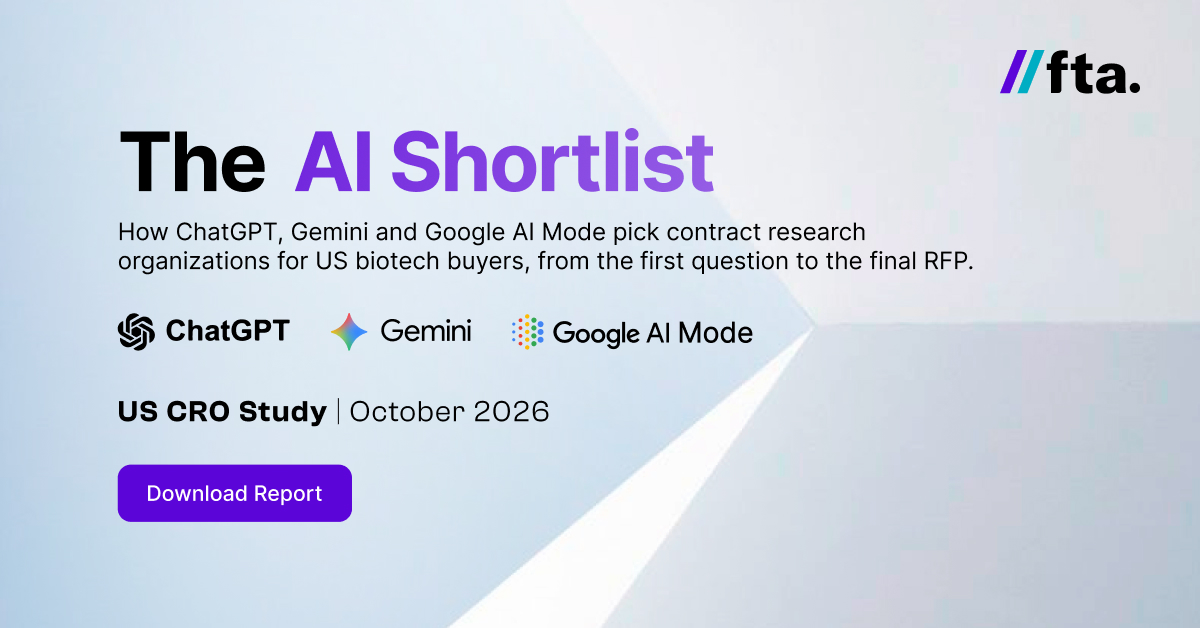
FTA’s US CRO study tested 420 buyer questions across ChatGPT, Gemini, and Google AI Mode. Eight of the ten leading CROs at the simulated long list stage remained among the top ten at the final RFP stage.
The study generated answers on October 15, 2026. It did not observe actual purchasing decisions, and the findings cannot establish how sponsors ultimately select partners.
It does, however, give marketing teams a reason to examine early discovery. If your company is missing from the relevant exploratory answers, check whether your public content clearly explains its suitability.
Start with the questions your business development team hears before an RFP, including sponsor size, therapeutic experience, service scope, and delivery expectations.
2. Scientific buyers need evidence of a specific fit
A company description such as full service life sciences partner leaves important questions unanswered. Buyers still need to know what the company can deliver, for which application, and under what conditions.
For example, a CDMO page should distinguish drug substance from drug product capabilities. It should explain supported modalities, development stages, facility locations, and relevant manufacturing scale where that information is approved for publication.
You can refer to this buyer’s evaluation criteria to decide what each page needs to contain.
3. Outdated information can misrepresent your business
Publishing new information does not ensure every AI answer will use it.
If a CRO expands into a new area but doesn't update its website, prospective sponsors won't see proof of the new service, and AI tools may share outdated details.
The marketing team needs to review the service descriptions, team profiles, and supporting project examples affected by that expansion. Keeping those sources current gives buyers accurate information to evaluate and search systems clearer evidence to reference.
For a B2B life sciences company, that review could uncover an obsolete service description, a former company name, or missing information about a facility expansion.
Assign an owner to important capability pages. Keep publication and review dates accurate, explain material changes, and connect archived announcements to current information where appropriate. Preserve necessary scientific and historical records.
Claims also need the right review. For prescription drug promotion, FDA emphasises accuracy, balanced information, and avoiding misleading claims. Apply the review process appropriate to your product and content, with scientific, medical, legal, and regulatory input where relevant.
Making information easier to find should preserve its scientific meaning and limitations.
4. Being cited does not necessarily mean being considered
An AI answer might cite your article to explain an analytical method without naming your company as a provider of that service.
Both appearances can be useful, but they serve different commercial purposes.
A technical article should explain the method accurately. A connected service page should establish whether you perform the work, which applications you support, and how a buyer can evaluate your suitability.
For instance, a laboratory supplier’s educational page could explain an assay workflow. Its product and application pages should then provide the compatibility information and performance evidence required to assess a purchase.
Review citations alongside the full answer. Check whether your company is used as an information source, included as a potential provider, or described in a way that requires correction. A single visibility score cannot explain all three.
5. Search content needs to respond to changing buyer questions
An adaptive cycle connecting data, insights, brand strategy, content, engagement, and measurement. Its discussion centres on patients and healthcare professionals.
Applied to B2B search, the useful principle is continuous learning from the audience.
Suppose a CDMO’s business development team starts receiving more questions about technology transfer responsibilities. Marketing can review whether the website addresses that concern, ask technical leaders to explain the process, and publish approved guidance linked to the relevant service.
The team can then monitor the questions attracting visitors and whether those visitors become qualified inquiries. That feedback should influence the next content update.
This gives life sciences SEO a defined role in commercial planning. Content priorities should follow the questions that affect buyer confidence and partner selection.
What should marketing leaders prioritize first?
Start with one commercially important service and the audience most likely to buy it.
- Document the buying questions. Ask sales and scientific teams what prospects need to establish before requesting a meeting or proposal.
- Check current visibility. Test representative questions across search and relevant AI platforms. Record the date, wording, sources, and company descriptions.
- Strengthen the service page. Explain the scope, applications, limitations, and supporting evidence buyers need to assess fit.
- Resolve access and content gaps. Review indexing, internal links, and whether critical information is available as readable text.
- Connect discovery to a useful next step. Offer a technical consultation, capabilities discussion, or proposal request appropriate to the buying stage.
A focused pilot makes it easier to identify which changes help and which questions still need better answers.
Make your expertise easier for buyers to evaluate
Your website should help a prospective partner understand what your company does, where its expertise applies, and what evidence supports contacting you.
FTA’s Search Engineering™ brings search strategy, scientific content, and AI visibility together around those buying questions. We help life sciences teams identify gaps in their service pages and assess how their companies appear across relevant searches and AI answers.
Frequently asked questions
1. What is life sciences SEO?
Life sciences SEO helps buyers find your company when they search for the scientific expertise, products, or services you provide. It brings together technical website improvements and content that explains your capabilities. For a CRO, that could mean helping a sponsor find evidence of your experience in a particular therapeutic area or trial phase.
2. Why do life sciences companies need SEO?
Your buyers need enough information to decide whether your company deserves further consideration. They may be assessing research experience, manufacturing capabilities, or compatibility with a laboratory workflow. SEO helps them find those answers while they research potential providers, giving your expertise a chance to influence the shortlist before a sales conversation begins.
3. Who should life sciences SEO content be written for?
Write for the people who evaluate, influence, and approve a purchase or partnership. These can include scientists, clinical operations leaders, pharmaceutical sponsors, laboratory managers, and procurement teams. A scientist may need application data. Procurement may need service responsibilities and supplier qualifications. Your content should answer the questions each person brings to the decision.
4. Where should a life sciences company aim to appear?
Aim to appear where buyers investigate the work your company does. That includes relevant search results, AI answers, and specialist publications or directories. Your brand should focus on questions about the services, applications, and delivery requirements you can support. A mention has greater commercial value when it connects your company to a relevant buyer need.
5. When should a life sciences company start investing in SEO?
Start once you have a defined offering, a clear audience, and evidence you can publish. Include SEO when planning a website, introducing a service, or entering a new market. This gives your scientific and marketing teams time to develop, review, and publish the information buyers need before commercial outreach begins.
6. How does FTA help life sciences companies improve search and AI visibility?
We start with how your buyers evaluate scientific and commercial fit. We map their questions by role, therapeutic area, development stage, and market, then assess how your company appears in search and AI answers. Those findings guide improvements to service pages, scientific content, supporting evidence, and technical accessibility. We track relevant visibility alongside qualified inquiries and opportunities.

Do you want more traffic?



How AI Decides Which Brands Belong in a Market Conversation