TL;DR
- What is on-page SEO? Improving a page’s content and structure to support search visibility and help visitors.
- On-page SEO includes content, HTML elements, and internal links. On-page SEO remains relevant to AI search.
- Understanding why on-page SEO is important starts with relevance. Buyers and search systems need clear, useful information.
- The main types of on-page SEO work cover content, page elements, links, media and usability.
- AI SEO and LLM SEO build on these foundations. Useful evidence matters more than repeated keywords, and citations are never guaranteed.
What is on page SEO?
On-page SEO improves a webpage’s content and HTML elements so search engines can understand it and users can find it useful.
The definition of on page SEO includes titles, headings, body copy, images, internal links and relevant structured data. It applies to service pages, product pages, articles and comparison pages.
For a marketing professional, on page SEO meaning is simple. Make each page explain its subject clearly, answer the intended audience’s questions and provide a useful next step.
Why on page SEO is important for search and AI visibility
Search visibility depends partly on whether a page addresses the question being asked. A software page targeting enterprise procurement needs details about approvals, supplier management, and integrations.
Clear, structured information helps users navigate easily and gives search engines precise content to process, while broad claims fail to answer core questions.
Google’s AI search experiences still rely on its core search systems. On page improvements remain relevant, although a strong ranking does not guarantee inclusion in an AI answer.
What are the benefits of on page SEO?
Understanding why on page SEO is important starts with what a useful page helps people do. Strong content and clear structure support discovery, evaluation and the next step.
- More relevant search visibility: Content that answers specific questions helps search engines understand when your page is useful.
- Clearer search listings: Descriptive titles and accurate summaries help people decide whether to visit your page.
- Easier evaluation: Clear explanations, product details, and supporting evidence help buyers assess whether your offering fits their needs.
- Better navigation: Relevant internal links guide visitors towards comparisons, case studies, and service information.
- A foundation for AI search: Google’s AI features use the same core SEO principles. Accessible, useful content supports eligibility, although inclusion is never guaranteed.
What are the key elements of on page SEO?
On page SEO brings together the content and page elements that help readers find answers and search engines understand your offering.
- Content: Answer the intended search query with accurate explanations, relevant examples, and evidence that supports your claims.
- Titles and descriptions: Write a distinct title tag and meta description that clearly explains the page’s subject and value.
- Headings and URLs: Organize information with descriptive headings and use a readable URL that reflects the topic.
- Internal links: Connect readers to relevant service pages, integration guides and case studies using descriptive link text.
- Images and video: Use visuals that clarify your content, descriptive image alt text, and captions or transcripts for videos.
- Structured data: Add appropriate markup that accurately reflects the information visible on the page.
For a marketing software page, these elements should explain capabilities, supported integrations, and practical requirements. Buyers need enough detail to assess whether the product fits their needs.
The comparison below shows how specific titles, headings, and content turn vague marketing claims into useful product information:
Each improvement gives buyers clearer information and helps search systems understand the page. Use only capabilities and results your business can substantiate.
How do you choose keywords and match search intent?
Choose one main intent for each page. Someone researching procurement software needs different information from someone comparing implementation partners or looking for a pricing estimate.
Use keyword volumes to understand demand, then assess commercial relevance. A narrow integration query may attract fewer searches but can help a buyer resolve a serious purchase objection.
Place the primary keyword naturally in the title, main heading and opening explanation. Include related terms where they add meaning, without chasing a fixed keyword density.
Consider a query like "which social media analytics tool supports custom reporting and team collaboration." Rather than echoing the entire phrase repeatedly across the page, directly address relevant details such as dashboard features, report exports, and user permissions.
Build supporting sections around real questions from sales calls, customer support and search data. Avoid creating separate, nearly identical pages for every wording variation.
How do you do on page SEO?
Start with a page that matters to your business. Review its purpose, content, structure, and usability before measuring results.
1. Match the page to search intent
Identify what the searcher wants to accomplish. A search for B2B email marketing software needs product capabilities, integrations, and pricing information. A search for how to improve email deliverability needs practical guidance.
Choose a primary keyword that matches the page’s purpose. Use related terms naturally where they help explain the subject.
2. Write a specific title and main heading
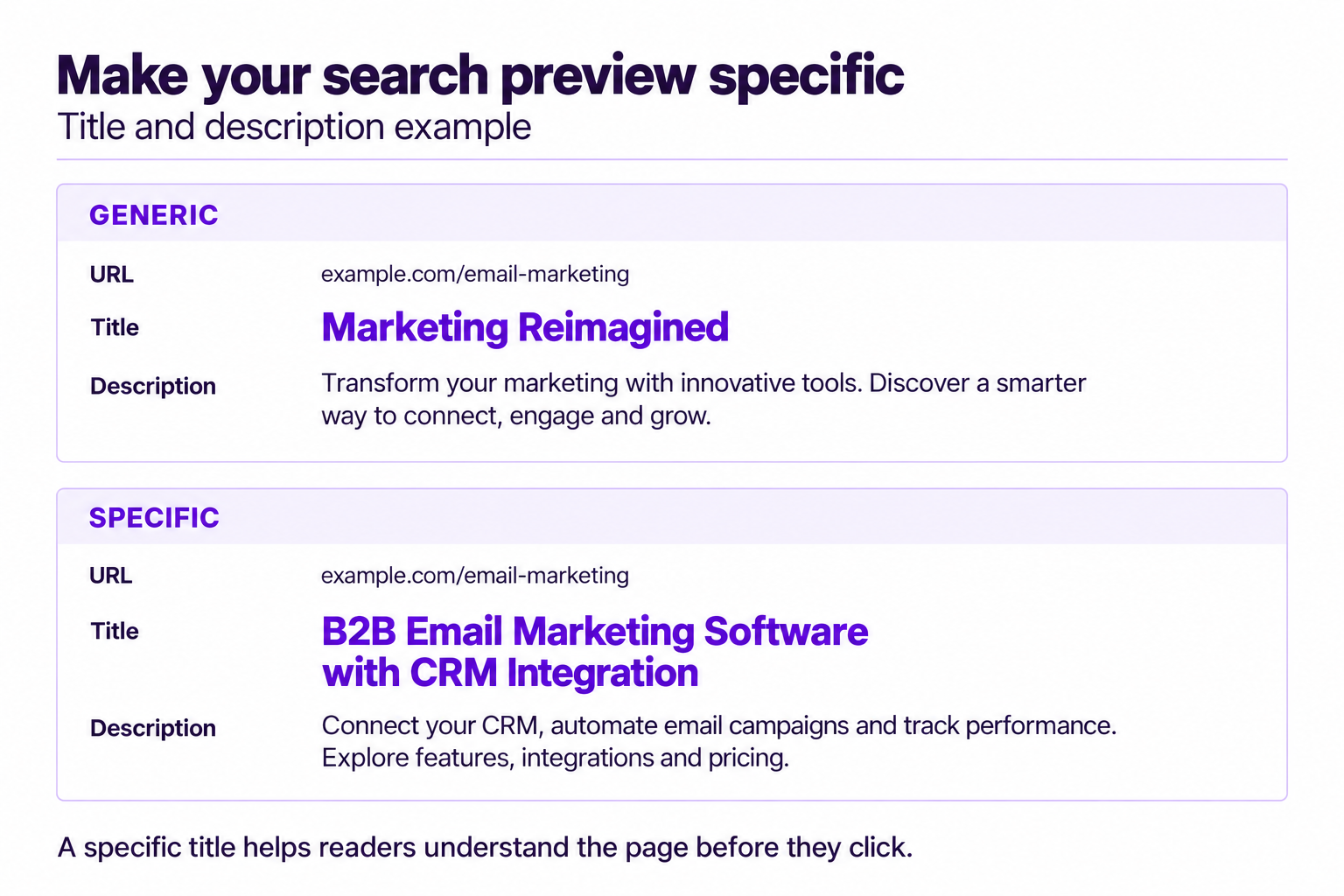
Make the subject clear in both the title tag and visible H1. For an email platform offering CRM integration, B2B Email Marketing Software with CRM Integration explains more than Marketing Reimagined.
Use H2s for the main questions and H3s for supporting details. Keep headings descriptive and avoid repeating keywords unnecessarily.
3. Improve the URL and meta description
Keep the URL descriptive and stable. Write a unique meta description that explains what the visitor will find and why the page is relevant.
Google may use your description or select another passage from the page. Treat it as a useful summary, without assuming it will always appear unchanged.
4. Answer questions with useful evidence
Explain capabilities, limitations and practical requirements. An email software page should clarify supported CRMs, automation options, reporting and onboarding.
Support claims with relevant screenshots, documented results or expert input. Keep product information and references current.
5. Connect related pages
Link to resources that help visitors continue their research. An email software page could connect to integration documentation, a deliverability guide and a customer case study.
Use descriptive link text so readers know what to expect before clicking.
6. Make images informative and accessible
Add screenshots or diagrams where they clarify an explanation. Use descriptive filenames and meaningful alt text, and compress images without making their details unreadable.
7. Check access, usability and structured data
Confirm that the page can be crawled and indexed. Test mobile readability, loading performance and forms, resolving technical issues with your development team.
Add relevant structured data that matches the visible content. Google does not require special AI markup for AI Overviews or AI Mode.
8. Measure and improve
Record performance before making changes. Track relevant queries, impressions, clicks and qualified inquiries, then use the findings to identify the next improvement.
Review AI mentions and citations separately, noting which questions and platforms you tested.
How should you optimize titles, headings, URLs, and descriptions?
A title tag describes the page in browser tabs and can influence its search result title.
For example, a marketing team that is looking for software to automate email campaigns. A title like ‘Email marketing software for B2B teams' clearly identifies the product and its audience. A vague title like Marketing reimagined leaves buyers guessing what the page offers.
Use a clear H1 for the main page topic, H2s for major questions, and H3s for supporting details. Keep headings descriptive enough for someone scanning the page.
Write concise, distinct titles without repeating keywords. Google may generate a different search title, and display length depends on the available space rather than a fixed character rule.
Keep URLs short, descriptive and stable. If an established URL must change, redirect it appropriately and update internal links.
Write a unique meta description explaining the page’s value. Google may use it as the search snippet or select text from the page instead.
What makes on page content useful for AI SEO and LLM SEO?
AI SEO commonly refers to improving visibility in AI search experiences. LLM SEO focuses on discovery and representation in answers produced by large language models, often using retrieved web sources.
Follow these four steps to improve your content for buyers and AI search:
- Add a comparison table only when buyers need to compare the same attributes.
- Publish evidence competitors cannot reproduce by rewriting your introduction. Relevant material could include a documented implementation process, an expert’s analysis or a customer result with its timeframe and measurement method.
- Name the author or reviewer where appropriate. Link factual claims to credible sources, and update information when product capabilities or supporting evidence change.
- Keep essential answers understandable in context. Short paragraphs help readers, but Google does not require tiny content chunks, special AI markup or an llms.txt file for AI search visibility.
FTA Global’s Search Engineering™ approach connects page improvements with the broader work of search discovery and AI visibility.
How do internal links, images, and schema support on page SEO?
Link related pages where the connection helps the reader. A procurement software page could link to integration documentation, a migration guide, and a relevant customer case study.
Use descriptive link text that explains the destination. Link important pages from relevant areas of the site rather than leaving them isolated.
Use descriptive image filenames and alt text that explains the visual. For a campaign dashboard, describe the channels and metrics shown rather than adding unrelated keywords.
Compress images, keep decorative images’ alt attributes empty, and provide text summaries or transcripts for important videos.
Structured data adds machine-readable information about a page. Use an appropriate supported type, such as Article or Product where applicable, and keep it consistent with visible content.
Use Google’s Rich Results Test to check supported markup and identify errors. Passing the test supports eligibility for richer search displays, but does not guarantee their appearance or an AI citation.
What should an on page SEO audit check?
Start with commercially important pages. Check whether each page answers its target question, supports its claims and offers a relevant next action, such as reviewing specifications or booking a demo.
Then verify that intended public pages can be crawled and indexed. Check accidental noindex tags, conflicting canonical URLs, broken links and whether essential information renders correctly.
Use PageSpeed Insights to check Core Web Vitals. Largest Contentful Paint measures loading, Interaction to Next Paint measures responsiveness, and Cumulative Layout Shift measures visual stability.
Reduce oversized images and unnecessary scripts. Check that mobile visitors can read content and complete forms without shifting buttons or intrusive overlays.
How do you measure on page SEO performance?
Record a baseline before editing. Use Search Console to track impressions, clicks, click-through rate and average position for relevant queries.
Review organic landing page traffic and tracked inquiries in GA4, then compare equivalent periods after the changes.
Use Search Console’s generative AI reporting to examine visibility in Google’s AI experiences.
For other AI platforms, sample consistent buyer questions over time. Record brand mentions, linked citations and factual accuracy separately. Treat those observations as a sample, not a complete picture of AI visibility.
Strengthen on page SEO across your key service pages
Effective on page SEO helps buyers understand your offering, assess its relevance and take the next step. Clear headings, specific answers and credible evidence support that journey across search results, AI answers and your website.
Start with your key service pages. FTA Global’s Search Engineering™ approach connects content and page improvements with search visibility, traffic and qualified enquiries.
FAQs
1. Should I update an existing page or create a new one for a related keyword?
Update the existing page when the keyword reflects the same audience need. Create a separate page when the searcher needs a different answer, format or offering. A guide to email automation and an email automation pricing page serve different purposes.
2. Can a blog and a service page target the same keyword?
Both can discuss the same topic, but each needs a distinct purpose. Let the blog explain the problem and the service page explain your solution. If both deliver nearly identical answers, review whether they should be differentiated or combined.
3. Why does Google show a different title from the one I wrote?
Google generates search titles using several sources, including title tags and visible headings. Vague, repetitive, or outdated titles may be replaced. Keep your title tag, H1, and page content consistent, then allow time for Google to recrawl the page.
4. Does a B2B service page need as much content as a detailed blog?
No fixed word count makes a page more useful or more likely to rank. A service page should explain suitability, scope, evidence, and the next step. Add detail when it resolves a buyer’s question, rather than matching a competitor’s length.
5. Why does my page rank in Google but not appear in AI answers?
A ranking does not guarantee selection for an AI answer. Google’s AI features can explore related questions and choose different supporting pages. Check whether your page answers the specific question clearly and remains indexed and eligible for search snippets.

Do you want more traffic?

What is Off page SEO? Definition, types, and AI search