

If your rank tracker showed a big crash between 20 September and early October, please do not touch your pages yet. There is a good chance your rankings did not drop at all. The data did.
Over the last few weeks, a lot of SEO people have been posting that their tools look broken. People have named Ahrefs, Semrush, SISTRIX and many smaller trackers, saying the numbers do not match what they see on Google.
I went through every study, vendor note and court filing I could find. Some of what is going around LinkedIn is solid. Some of it is a guess being passed around as fact. In this post I will separate the two, show you the numbers, and tell you what I would do this week if I were running SEO for a brand.
What is happening, in simple words
Google is making it harder and costlier for machines to collect its search results. SEO rank trackers get caught in this, even if they are not the main target.
Here is how a rank tracker works. It sends a search to Google from a server, reads the results page, and notes where your site shows up. It does this thousands or millions of times a day.
Derek Perkins of Nozzle, a rank tracking company, told Search Engine Roundtable that Google is now pushing back in three ways:
- Wide IP blocking. Google is blocking big residential proxy networks, the pools of IP addresses that scrapers use to look like normal users.
- More CAPTCHAs. Many more "prove you are human" checks.
- Bad data. Some requests that look like bots get a normal-looking results page with different websites on it.
The first two are old tricks. The third one is new, and it is the real problem.
Think about it like this. Your client ranks number 2 for an important keyword. A real customer searches and sees them at number 2. But the rank tracker gets a different page where your client is not there at all. The report shows a crash. Your client calls you. Nothing actually happened.
A blocked request at least tells the tool to try again. A poisoned page looks normal, so the tool saves it as real. Missing data is annoying. Believable wrong data is dangerous.
The research: 27.5 million results pages
On 10 October 2026, Nozzle published a study called Poisoned Google SERPs. It is the most detailed public data on this so far.
Nozzle compared each keyword's results with that same keyword's normal history. If more than half of a keyword's usual websites vanished from every page, and then came back later, Nozzle called that page "poisoned".
What they found:
- 27.5 million results pages, from 20 August to 9 October, across 49 countries and desktop, iPhone and Android.
- 8.0% poisoned since 13 September. Before that, the normal rate was 0.17%. That jump is the real story.
- On the worst days, 27 to 29 September, about one in four pages was poisoned. From 1 October it has been running at roughly 5 to 11% a day.
- When a page was poisoned, a tracked site fell out of the top 10 58.6% of the time, against 2.7% in normal times.
- It does not last. 77.9% of poisoned pages had their usual sites back within three days, and most poisoning spells were a single check.
One honest note on the 8%. It is 8% of the pages Nozzle could judge, meaning keywords with enough history to compare. It is not 8% of all Google searches.
What about India?
India is hit harder than the US in Nozzle's sample.
Two more things from the study matter for anyone running local or long-tail SEO. "Near me" searches were poisoned more often (11.4%) than other searches (7.8%). Brand searches were poisoned the least (5.3%).
And here is the strange part. The rate also depended on which route the request took to reach Google. Between 30 September and 9 October, one of Nozzle's collection routes got 1 to 7% poisoned pages while another got 9 to 30%, on the same days. So your tool's numbers depend a lot on how your vendor collects data.
How it unfolded
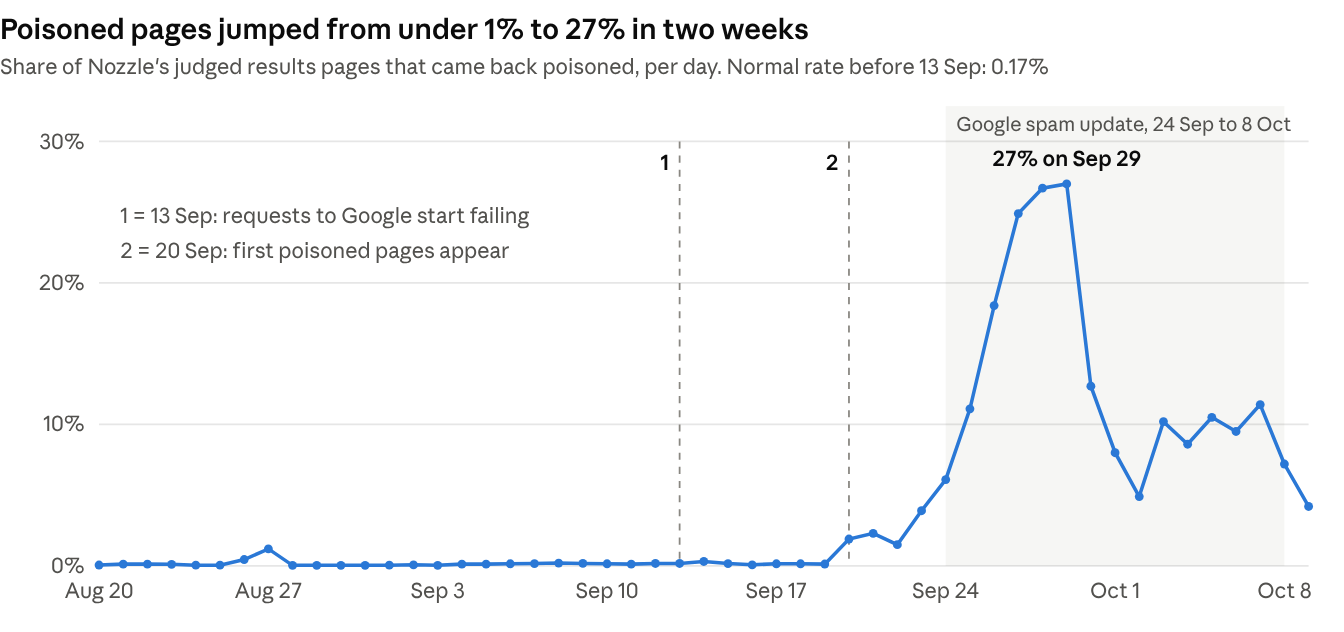
Nozzle, Poisoned Google SERPs, daily data 20 Aug to 9 Oct 2026. The last three days are still filling in, so they may rise.
DemandSphere saw unusually aggressive blocking from around 11 September. Nozzle's requests started failing in large numbers on 13 September. From 20 September, the requests that got through started coming back poisoned. It peaked at 27% on 29 September and has stayed at roughly 5 to 11% a day since 1 October. It is better than the peak, but it has not gone away.
The story went public over one week:
It is not just one company saying this
If only one vendor had reported this, I would be careful. But several companies, using different data and different methods, saw the same thing around the same time.
These numbers use different definitions, so please do not compare them directly. What matters is that they all point the same way.
Others also flagged problems, according to Search Engine Roundtable: DataForSEO and SE Ranking on their status pages, and Advanced Web Ranking on its blog.
The Morningscore test is the one that convinced me
Morningscore, a Danish SEO tool, did something simple and smart. While its tracker was getting cut-short results, the team ran the same searches in a normal Chrome browser from ordinary Danish internet connections. The browser got the full results.
On the bad pages, about 8 of the previous top 10 websites were missing on average, sometimes even the number 1 result.
They also saw that different data providers got very different results for the same keywords at the same time. On 2 October, one provider got cut-short pages for up to 72% of searches. Another got them for only 1 to 3%.
So real people searching on Google were most likely seeing normal results. The bad pages were going to machines. Morningscore says it cannot prove this from outside, but that is what its data shows.
Credit to Morningscore for one more thing. Their CEO openly said that recording these as real ranking drops was their own mistake and apologised. That kind of honesty is rare in our industry.
What changes inside a poisoned page
The organic results get swapped out, but the parts advertisers pay for stay almost the same. Nozzle compared each part of the page with that keyword's previous check.
The page also looks a bit different. AI Overviews showed up on 34.9% of poisoned pages against 54.2% normally. Image packs nearly doubled, from 23.0% to 44.2%. And the page numbers at the bottom often stop at page 3 or 4.
Social sites and forums fill the gap. Reddit was in the top 10 of 28.8% of poisoned pages, against 20.8% of the same keywords' other pages. Facebook, LinkedIn, Instagram and Quora also went up. YouTube, Yelp and MapQuest went down.
One example from the study. The search "white label local seo" normally shows SEO vendors like BrightLocal and Synup. On the poisoned page three days later, all nine page-one sites were gone. In their place: a WordPress tool, a steakhouse, and some government websites.
Please do not read this as "Google now loves Reddit". These are the odd pages that rank trackers received. They tell us nothing about what real users see.
Which industries got hit most (US data)
If you track legal, home services, travel or finance keywords, assume your late-September data is the least reliable.
Why would Google do this?
The short answer: AI. Almost everyone close to this believes the real target is AI companies pulling Google's results to power their own answers. Rank trackers collect results the same way, so they get caught in it.
Think about it from Google's side. When ChatGPT or any AI assistant answers a question with fresh web information, that data has to come from somewhere. Scraping Google's results, directly or through data sellers, is one of the easiest ways. To Google, a rank tracker and an AI company buying search data can look exactly the same: a machine sending lots of searches.
What the people closest to it say:
- SISTRIX says it believes Google mainly wants to stop new competitors like ChatGPT from using its index, and to stop its results being used to train open AI models, for example from China. It says tools like SISTRIX are not the target.
- DemandSphere's Ray Grieselhuber says Google does not care about SEO tools and is worried about AI labs like OpenAI and Anthropic. He calls the SEO industry "caught in the crossfire".
- Nozzle goes further and states it plainly as Google's response to AI scraping. That is their reading of the evidence, not something Google has said.
This has been building for a year
The poisoning did not come out of nowhere. Look at the steps:
- September 2025: Google stopped allowing 100 results on one page (the num=100 parameter). Trackers now need about 10 requests to see what used to take one.
- December 2025: Google sued SerpApi, a company that sells Google search data through an API, for getting around its anti-bot system.
- Early July 2026: Google started testing google.com/goto redirect links in results. A tool can no longer read the destination URL from the page; it has to follow each link. Also in July, DemandSphere notes, the FBI seized a large proxy network called NetNut and appears to have worked with Google on it. NetNut's parent company disputes the allegations.
- 20 July 2026: A US judge dismissed Google's case against SerpApi, ruling that plain search results are not copyrighted works. Google was allowed to refile only for licensed content.
- 10 August 2026: Google filed an amended complaint. SerpApi asked the court to dismiss it again on 24 August. I could not find a ruling on that yet.
- 26 August 2026: Google confirmed the goto rollout to Search Engine Roundtable, with only a general line about its "long history of deploying technical measures against evolving forms of abuse."
- Around 11 to 13 September 2026: Very aggressive blocking starts. Then from 20 September, the poisoned pages.
My read: Google is not trying to make scraping impossible. It is trying to make it slow, costly and unreliable. When the legal route did not go its way in July, the technical route got sharper. That last link is my interpretation. Nobody has proved the court case triggered the September changes.
What is confirmed, and what is still a theory
This is where a lot of LinkedIn posts go wrong. They take a strong theory and write it like a fact. Here is how I would grade each claim today.
As of 14 October, I could not find any Google statement about poisoned results. The only on-record Google line is the general one about the goto links.
Do not blame everything on poisoning
Here is the catch. Google's September 2026 spam update ran from 24 September to 8 October. That overlaps almost fully with the poisoning.
So some of the drops you saw in late September are real. Glenn Gabe shared a case where a site really did get hit on 29 September, and the owner confirmed it. Ahrefs caught that drop, Semrush caught it late, and SISTRIX had not shown it.
That cuts both ways. Some fake drops look real, and some real drops get hidden. The fix is the same: do not trust one tool's number on its own. Check it against Search Console.
What's my take on this
For 20 years, "what rank are we?" has been the first question in every SEO review. I think this episode tells us that number is getting weaker as a single source of truth.
A rank tracker was always a sample. One machine, one location, one moment. It worked well enough because Google mostly let it. Now Google has shown it can quietly hand machines a different page whenever it wants. That will not fully go away, even if the tools catch up.
At the same time, more and more of the answer is not even a blue link. It is an AI Overview, AI Mode, or a ChatGPT answer. So the real question for a brand is shifting from "where do we rank?" to "are we being found, chosen and cited, and is it bringing business?"
This is how we think about measurement in Search Engineering at FTA. Rankings are one signal. First-party data like Search Console, traffic and leads is the base. And AI visibility is now a layer of its own.
What I would do this week
- Do not change pages because of a drop between 20 September and early October. Wait for the next few checks first. Most poisoned results came back within three days.
- Open Search Console for every keyword that dropped. If impressions and clicks held steady, nothing happened to your site.
- Look at keywords together, not one by one. Many keywords dropping on the same day and coming back a day later is a data problem, not a ranking problem.
- Compare against the keyword's normal history, not just yesterday. Yesterday may have been a poisoned check too.
- Separate the spam update. If a drop holds past 8 October and shows in Search Console, treat it as real and look into it properly.
- Tell your clients or your boss before they ask. A short note today saves a panic call next week.
- Ask your rank tracking vendor three questions:
- How do you detect and remove poisoned or cut-short results?
- Which of my historical data from 20 September to now did you correct?
- How often are my keywords actually being refreshed right now?
If your vendor cannot answer these clearly, that tells you something too.
The tools will adjust. Google will change again. Brands that tie SEO to real business numbers will not panic every time a chart moves.
Sources
- Poisoned Google SERPs, Nozzle, 10 Oct 2026
- Third-Party Google Rank Tracking Struggling Now, Search Engine Roundtable, 12 Oct 2026
- Spurious data in Google SERPs, DemandSphere, 7 Oct 2026
- Google's Summer of Love, DemandSphere, 24 Sept 2026
- Google gave rank trackers truncated results for a week, Morningscore, 8 Oct 2026
- Why Google ranking data collection is changing, SISTRIX, 7 Oct 2026
- Confirmed: Google Search rolling out google.com/goto, Search Engine Roundtable, 26 Aug 2026
- Google lawsuit against SerpApi dismissed, Search Engine Roundtable, 22 Jul 2026
- Google amends SerpApi suit with content licensing terms, Search Engine Journal, Aug 2026
- SerpApi asks judge to end Google's scraping case, PPC Land, Aug 2026

Do you want more traffic?


OpenAI Dots Explained: How ChatGPT’s Always-On Agents Work, and How They Compare to Meta Muse
.jpg)